

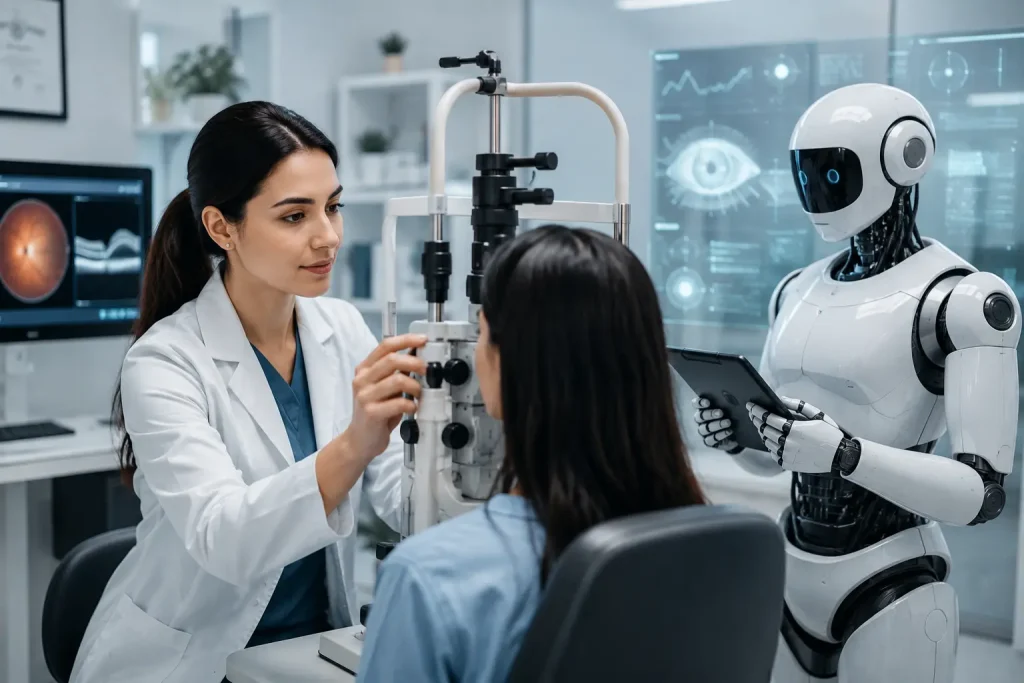
Will AI replace optometrists? No. AI is a powerful assistant that improves screening speed, diagnostic consistency, and access, especially for diabetic retinopathy, glaucoma, and AMD. The optometrist remains essential for clinical judgment, prescribing, complex management, patient counseling, and ethical responsibility. Professionals who learn to use AI tools will have stronger job security and higher value.
Artificial intelligence is transforming eye care by analyzing retinal images, OCT scans, and clinical data faster and often more consistently than humans alone for specific tasks. Systems already detect referable diabetic retinopathy autonomously in primary-care settings, support glaucoma and AMD screening, aid refractive error management, and help prioritize patients. Global shortages of eye-care professionals and rising vision impairment make AI particularly valuable in low- and middle-income settings. In optometry, AI optimizes every stage—screening, detection, diagnosis, and management—while the licensed clinician retains final responsibility.
Kerala has taken a pioneering step with Nayanamritham 2.0, the world’s first government-backed AI-assisted program screening for diabetic retinopathy, glaucoma, and age-related macular degeneration. Optometrists use AI-enabled fundus cameras that classify cases as referable or non-referable in real time, allowing ophthalmologists to focus on complex care. This model shows how AI expands rather than shrinks the role of trained optometrists.
AI delivers measurable advantages: higher sensitivity and specificity in detecting referable disease (often >90–95% in validated systems), reduced time per screening, improved consistency across observers, earlier detection of progression, and better access in underserved areas through portable cameras and tele-optometry. Multimodal systems that combine fundus photography, OCT, and clinical data further improve accuracy. For students and practitioners, AI frees time for patient interaction, specialty care (contact lenses, myopia control, low vision), and complex decision-making.
AI is not perfect. Performance depends on image quality, training data diversity, and population differences. Real-world deployment faces non-diagnostic images, workflow integration, regulatory hurdles, data privacy, and the need for clinician oversight. Explainability, bias monitoring, and prospective validation remain active research areas. Over-reliance without proper training can create risk; the safest model is AI as decision support under human supervision.
AI expands rather than contracts roles. New or enhanced opportunities include:
Demand for optometrists remains strong because of workforce shortages and expanding scope of practice. AI-skilled graduates are more attractive to employers in India and the GCC.
In Kerala, entry-level optometrist salaries in private practice typically range from ₹15,000–₹25,000 per month, with government or experienced roles higher. Corporate and hospital positions can start higher. Professionals with strong clinical skills plus familiarity with modern diagnostic and AI tools command better packages. In GCC countries (UAE, Saudi Arabia, Qatar, etc.), experienced optometrists often earn ₹1,00,000–₹2,50,000+ per month (tax advantages apply), especially those who clear licensing exams (DHA, MOH, Prometric) and demonstrate competence with advanced technology. AI literacy is increasingly a differentiator for international placements.
By 2026 and beyond, AI-powered diagnostics are expected to become standard. Trends include individualized risk prediction, home OCT monitoring with AI triage, predictive models for disease progression, multimodal agents that integrate imaging and evidence, and greater use in refractive error management and myopia control. Optometry’s future favors those who embrace innovation: the profession shifts toward higher-value medical and specialty care while AI handles high-volume screening. Employment projections in major markets remain positive; AI augments productivity rather than eliminating licensed roles.
Practical applications already in use or near-term: autonomous diabetic retinopathy screening (FDA-cleared systems), AI analysis of OCT for AMD and glaucoma, portable handheld retinal cameras with AI interpretation, support for refraction and spectacle/contact lens recommendations, and emerging multimodal agents that generate evidence-grounded reports. In Kerala, Remidio AI-enabled cameras are deployed in public health settings. Future tools will include better predictive analytics, oculomics (retinal signs of systemic disease), and tighter integration with electronic health records. Optometrists who understand both the clinical science and the strengths/limitations of these tools will lead practices.
Kerala’s high literacy, dense hospital network, and progressive public health initiatives create strong demand for skilled optometrists. Nayanamritham 2.0 positions the state as a global leader in AI-assisted public eye screening and explicitly empowers optometrists. Private eye hospitals, optical chains, and institutions such as Al Salama (with its college of optometry and affiliated hospital network) provide clinical training grounds where students encounter modern diagnostic technology. Local graduates can move into screening programs, hospital roles, private practice, or use the experience as a springboard to GCC opportunities. The combination of solid clinical education and exposure to AI tools is a competitive advantage.
India faces a significant shortage of eye-care professionals relative to the burden of uncorrected refractive error, diabetic retinopathy, glaucoma, and cataract. AI enables task-shifting and scale-up of screening, particularly in primary care and rural settings. National programs and private networks increasingly adopt AI tools. Optometrists who combine traditional skills with digital literacy are well placed for roles in corporate hospitals, NGOs, research, and industry.
GCC countries offer attractive salaries and demand for qualified optometrists. Familiarity with AI-assisted diagnostics, modern imaging, and evidence-based practice improves employability and licensing success. Broader opportunities exist in research collaborations, tele-optometry platforms, and multinational optical/eye-care companies.
A strong foundation is a recognized BSc Optometry (or equivalent) with solid clinical internship, preferably from institutions that provide hospital-based training. MSc Optometry or specialized fellowships deepen expertise. Essential skills going forward: proficiency with diagnostic imaging (fundus, OCT), understanding of AI output interpretation and limitations, patient communication, ethical decision-making, and continuous learning. Institutions that integrate practical exposure to current technology and encourage critical thinking about AI tools prepare graduates best.
AI does not make traditional clinical skills obsolete; it raises the floor for screening accuracy and volume while increasing the value of human judgment, empathy, and complex care. Compared with purely manual workflows, AI-augmented practice allows more patients to be served with higher consistency. Compared with pure ophthalmology pathways, optometry remains accessible (no NEET for most allied health routes), offers strong primary-care and specialty options, and benefits directly from AI screening models that expand the optometrist’s role.
AI is reshaping eye care, but it is creating a stronger, more efficient profession rather than ending careers. Students who choose a solid, clinically oriented optometry program, master both traditional skills and emerging technology, and stay adaptable will find excellent opportunities in Kerala, across India, and abroad—particularly in the GCC.
If you are exploring BSc or MSc Optometry, allied health pathways, or want guidance on how technology is integrated into training, speak with academic counselors at established institutions that combine classroom learning with real hospital exposure. Informed decisions today position you for a resilient and rewarding career in the evolving field of eye care.


