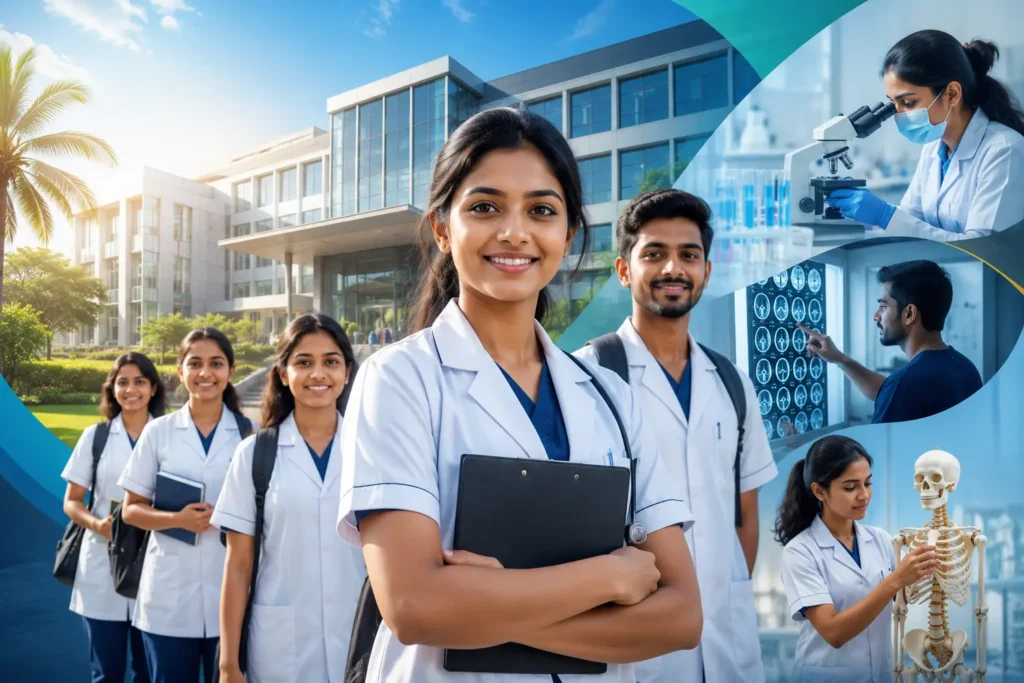
Best Paramedical College in Kerala 2026 | Top Courses, Fees & Admission Guide
Quick Answer
The best paramedical colleges in Kerala offer AICTE/UGC-approved programs, modern clinical labs, and strong hospital tie-ups. Al Salama College of Allied Health Sciences, Perinthalmanna, is among Kerala's leading institutions, providing WHO-aligned paramedical education with placement support and career-focused training across 10+ allied health courses.
Table of Contents
- What Is a Paramedical College?
- Why Choose Kerala for Paramedical Studies?
- How to Identify the Best Paramedical College
- Top Paramedical Courses Available in Kerala
- Eligibility Criteria
- Fees Structure
- Skills You Need to Succeed
- Career Opportunities After Paramedical Courses
- Salary Expectations
- Government Jobs After Paramedical Courses
- Private Sector and Abroad Opportunities
- Higher Studies Options
- AI Applications in Paramedical Sciences
- Future Scope
- Advantages of Studying Paramedical in Kerala
- Common Mistakes to Avoid While Choosing a College
- Latest Trends in Paramedical Education (2025)
- Expert Tips for Admission
- Conclusion
- FAQs
1. What Is a Paramedical College?
A paramedical college trains healthcare professionals who support doctors and nurses in delivering patient care. Paramedical professionals include laboratory technicians, physiotherapists, radiographers, optometrists, operation theatre technicians, dialysis technicians, and many others.
These colleges offer diploma, certificate, and degree-level programs that equip students with clinical skills, diagnostic knowledge, and hands-on training — making them indispensable to India's healthcare system.
Did you know? According to the National Health Policy, India needs over 3.4 million additional allied and healthcare workers to meet the growing demand by 2030.
2. Why Choose Kerala for Paramedical Studies?
Kerala is widely regarded as India's healthcare capital. Here's why:
- Highest hospital density per capita among Indian states
- Strong government and private hospital network (KIMS, Aster, Malabar Hospital, Government Medical College chains)
- Reputed medical universities such as the Kerala University of Health Sciences (KUHS) and Calicut University
- High employment rate for paramedical graduates within and outside the state
- Gulf corridor advantage — Kerala’s proximity to the Middle East opens international placement routes for trained paramedical professionals
- Affordable education costs compared to metros like Delhi, Bangalore, or Mumbai
Kerala's Directorate of Medical Education (DME) and the Kerala University of Health Sciences (KUHS) provide structured regulatory oversight, ensuring consistent quality across affiliated colleges.
3. How to Identify the Best Paramedical College in Kerala
Not all colleges offering paramedical courses are equal. Here are the key criteria to evaluate before choosing:
3.1 Regulatory Approvals
Approval Body | What It Ensures |
AICTE | Technical course standards |
UGC | University affiliation recognition |
KUHS | Paramedical degree program standards in Kerala |
NMC / PCI | Clinical standards for specific allied courses |
State DME | Government-level course recognition |
Always verify KUHS affiliation and relevant regulatory approvals before admission.
3.2 Hospital Tie-ups & Clinical Training
A paramedical course without strong hospital internship facilities is incomplete. Top colleges partner with multi-specialty hospitals to provide hands-on clinical training — which is critical for employment.
3.3 Faculty Qualifications
Check whether the faculty hold postgraduate degrees and relevant clinical experience. Industry-experienced faculty translate textbook knowledge into practical skills.
3.4 Placement Record
Look for colleges with documented placement records, industry tie-ups, and alumni working in reputed hospitals or abroad.
3.5 Infrastructure
- Modern laboratory equipment
- Simulation labs
- Digital learning tools
- Library with updated medical references
3.6 Course Diversity
The best colleges offer a wide range of allied health courses under one campus, giving students flexibility and options.
4. Top Paramedical Courses Available in Kerala
Course | Duration | Level |
B.Sc Optometry | 4 years | Degree |
B.Sc Medical Lab Technology (MLT) | 3 years | Degree |
B.Sc Cardiac Care Technology | 3 years | Degree |
B.Sc Radiotherapy Technology | 3 years | Degree |
B.Sc Operation Theatre Technology (OTT) | 3 years | Degree |
B.Sc Physiotherapy (BPT) | 4.5 years | Degree |
B.Sc Renal Dialysis Technology | 3 years | Degree |
B.Sc Physician Assistant | 3 years | Degree |
Diploma in Medical Lab Technology | 2 years | Diploma |
Diploma in Operation Theatre Assistance | 1–2 years | Diploma |
B.Sc Critical Care Technology | 3 years | Degree |
B.Sc Anaesthesia Technology | 3 years | Degree |
Al Salama College of Allied Health Sciences offers more than 10 KUHS-affiliated allied health programs from its main campus in Perinthalmanna, Malappuram — strategically located in northern Kerala's growing healthcare belt.
5. Eligibility Criteria
For Degree Programs (B.Sc Allied Health Sciences)
- Qualification: 10+2 (Plus Two) with Science stream (Physics, Chemistry, Biology)
- Minimum Marks: 50% aggregate (45% for SC/ST candidates as per KUHS norms)
- Age: Generally 17 years or above at the time of admission
- NEET: Not mandatory for most paramedical courses (unlike MBBS/BDS/BPT)
For Diploma Programs
- Qualification: 10th pass or 10+2 (course-dependent)
- Age: 16 years or above
Note: Eligibility norms may vary by course and institution. Always check KUHS guidelines and the specific college's prospectus before applying.
6. Fees Structure
Paramedical course fees in Kerala vary depending on the college type (government, private aided, or self-financing) and the specific program.
College Type | Approximate Annual Fee Range |
Government Paramedical Colleges | ₹15,000 – ₹40,000 |
Private Aided Colleges | ₹40,000 – ₹80,000 |
Private Self-Financing Colleges | ₹60,000 – ₹1,50,000 |
- Scholarship options are available for economically weaker sections through state government schemes, OBC scholarships, and institution-level fee waivers
- Bank loans (education loans) are available through nationalised banks under government education loan schemes
Compare total program cost, not just the first-year fee. Factor in hostel, lab fees, and clinical training charges.
7. Skills You Need to Succeed in Paramedical Sciences
Paramedical careers demand a mix of technical competence and interpersonal qualities:
Technical Skills
- Understanding of human anatomy and physiology
- Proficiency in operating diagnostic equipment
- Clinical documentation and record-keeping
- Infection control and sterilisation protocols
- Knowledge of relevant diagnostic or treatment software
Soft Skills
- Empathy and patient communication
- Attention to detail and accuracy
- Teamwork in clinical environments
- Composure under pressure (especially in critical care or OT settings)
- Continuous learning mindset (medical knowledge evolves rapidly)
8. Career Opportunities After Paramedical Courses
Paramedical professionals are among the fastest-growing segments of India's healthcare workforce. Here are the primary career paths:
8.1 Hospital-Based Roles
- Medical Laboratory Technician
- Radiographer / X-ray Technician
- Cardiac Technician / ECG Technician
- OT Technician / Scrub Technician
- Dialysis Technician
- Anaesthesia Technician
- Critical Care Technician
- Optometrist / Vision Therapist
- Physiotherapist
8.2 Diagnostic Centre and Clinic Roles
- Lab Analyst
- Imaging Technician
- Audiologist (with further qualification)
- Ophthalmic Assistant
8.3 Public Health and Community Roles
- Primary Health Centre (PHC) Technician
- National Health Mission (NHM) worker
- Blood Bank Technician
9. Salary Expectations
Role | Entry-Level Monthly Salary (India) | Experienced (5+ years) |
Medical Lab Technician | ₹18,000 – ₹30,000 | ₹40,000 – ₹70,000 |
Radiographer | ₹20,000 – ₹35,000 | ₹45,000 – ₹80,000 |
Optometrist | ₹18,000 – ₹32,000 | ₹40,000 – ₹75,000 |
Physiotherapist (BPT) | ₹22,000 – ₹40,000 | ₹50,000 – ₹1,00,000 |
OT Technician | ₹18,000 – ₹28,000 | ₹35,000 – ₹65,000 |
Cardiac Technician | ₹20,000 – ₹35,000 | ₹45,000 – ₹80,000 |
Gulf (Middle East) Salaries are significantly higher — MLTs and OT technicians frequently earn between AED 3,000–6,000/month (approx. ₹67,000–₹1,35,000/month), depending on the country and employer.
10. Government Jobs After Paramedical Courses
Government paramedical recruitment in Kerala is conducted through:
- Kerala Public Service Commission (KPSC) — regular notifications for Lab Technicians, Radiographers, Physiotherapists in Government Hospitals and PHCs
- National Health Mission (NHM) — contract-based positions across Kerala
- Central Government — AIIMS, ESIC, Railway Hospitals, Armed Forces Medical Services
- UPSC / SSC — some allied health roles through combined recruitment
Government posts offer job security, pension benefits, and structured pay scales under the 7th Pay Commission framework.
Tip: Prepare for KPSC exams alongside your degree coursework. Joining subject-specific coaching or using KPSC previous papers gives a competitive edge.
11. Private Sector and Abroad Opportunities
Private Sector
Kerala's private hospital sector — anchored by major chains like Aster Medcity, KIMS, Malabar Hospital, Baby Memorial, and Sunrise Hospital — offers abundant employment for paramedical graduates. Corporate diagnostic chains such as SRL Diagnostics and Metropolis also recruit aggressively.
Abroad Opportunities
Country | Common Demand | Certification Required |
UAE / Qatar / Saudi Arabia | MLT, OT Tech, Radiographers | Dataflow verification, Prometric exam |
UK | Physiotherapy, Radiography | HCPC registration |
Canada | All allied health | CAPER / provincial licensing |
Australia | Physiotherapy, MLT | AHPRA registration |
USA | Radiography, MLT, Physiotherapy | NCLEX / ASCP / ARRT certification |
Kerala's paramedical graduates have a historically strong placement record in the Gulf, owing to cultural familiarity, English proficiency, and the wide recognition of Indian clinical qualifications.
12. Higher Studies Options
Completing a B.Sc in an allied health field is not the final destination. Higher study options include:
- M.Sc in Medical Lab Technology / Optometry / Physiotherapy / Radiology — offered by KUHS, Manipal, MAHE, and other universities
- MBA in Hospital Administration / Healthcare Management — opens management-track careers
- Post-Graduate Diploma programs — in specialisations like cardiac electrophysiology, neuro-physiotherapy, or retinal imaging
- PhD in Allied Health Sciences — for research and academic careers
- Certification courses abroad — for licensure in Gulf and Western countries
13. AI Applications in Paramedical Sciences
Artificial Intelligence is reshaping how paramedical professionals work. Here's how AI is entering each field:
Paramedical Field | AI Application |
Medical Lab Technology | Automated cell counters, AI-driven pathology slide analysis |
Optometry | AI retinal screening tools (e.g., IDx-DR, Google DeepMind Eye AI) |
Radiology / Radiography | AI image analysis for X-ray, CT, MRI interpretation |
Physiotherapy | AI rehabilitation apps and wearable sensors |
Cardiac Technology | AI ECG interpretation (e.g., AliveCor KardiaMobile) |
Dialysis | Smart dialysis machines with auto-monitoring |
Students who combine paramedical expertise with basic AI literacy — understanding how AI diagnostic tools work — will be significantly more employable in the hospitals of 2026 and beyond.
Top colleges are beginning to integrate AI orientation sessions, digital health modules, and simulation-based training into their allied health curricula. Look for colleges that are already doing this.
14. Future Scope of Paramedical Education in Kerala
- India’s healthcare sector is projected to reach USD 638 billion by 2025, according to IBEF
- Allied health professionals constitute approximately 60% of the total healthcare workforce globally (WHO)
- India currently has a significant shortfall of allied health workers, creating sustained demand
- Kerala’s Medical Tourism industry generates consistent demand for trained paramedical staff
- Post-COVID healthcare expansion has increased ICU, dialysis, and respiratory therapy hiring substantially
- Government initiatives like Ayushman Bharat and expanded ESIC coverage are increasing institutional healthcare demand across India
15. Advantages of Studying Paramedical in Kerala
✅ Recognised affiliations under KUHS with national and international validity
✅ Affordable living and education costs compared to metro cities
✅ High hospital density for clinical training and placement
✅ Gulf recruitment advantage — Kerala is the largest source of healthcare workers for GCC countries
✅ Strong alumni networks from established colleges
✅ English medium instruction across most programs
✅ Safety and quality of life on campus and off
16. Common Mistakes to Avoid When Choosing a Paramedical College
❌ Choosing a college without verifying KUHS/AICTE affiliation — Some unrecognised institutions operate without proper approvals, and degrees from these colleges carry no value.
❌ Deciding based on fee alone — The cheapest option may lack hospital tie-ups, experienced faculty, or proper labs.
❌ Ignoring placement records — Always ask for actual placement data, not just promises.
❌ Not visiting the campus — A physical visit (or virtual tour) reveals the real infrastructure.
❌ Overlooking faculty experience — Faculty with only academic backgrounds, without clinical exposure, cannot train you adequately for hospital work.
❌ Skipping the hospital tie-up check — Clinical internship quality directly determines your employability.
❌ Not researching course recognition abroad — If you plan to work in the Gulf or elsewhere, confirm your specific course and institution are recognised by that country’s health authority.
17. Latest Trends in Paramedical Education (2026)
- Simulation-based training is replacing traditional mannequin labs — high-fidelity simulators now replicate real clinical environments
- Blended learning models (classroom + online modules) are being adopted post-COVID
- AI and digital health literacy is becoming part of core allied health curricula
- IPE (Interprofessional Education) — training paramedical and nursing students together to improve team-based care — is gaining traction in progressive institutions
- Competency-Based Medical Education (CBME) principles are being adapted for allied health programs
- Tele-rehabilitation and remote monitoring skills are being added to physiotherapy and cardiac programs
18. Expert Tips for Admission
"Before you apply, call the hospital — not just the college. Ask them if they recruit graduates from that institution. Their answer will tell you more than any brochure." — A practising senior physiotherapist in Malappuram
Step-by-step admission guidance:
- Shortlist courses based on aptitude — Lab-oriented (MLT, Pathology), Patient-care (OT, ICU, Cardiac), or Vision-related (Optometry)?
- Verify KUHS recognition at kuhs.ac.in before contacting any college
- Visit or schedule a virtual tour of shortlisted colleges
- Ask specifically: How many students were placed last year? In which hospitals? In which countries?
- Check hostel and transportation availability if you’re relocating
- Apply early — good colleges fill seats quickly, especially after Plus Two results
- Cross-check scholarship eligibility before finalising your decision
19. Conclusion
Choosing the best paramedical college in Kerala is one of the most important decisions you will make for your healthcare career. Kerala's regulatory environment, hospital ecosystem, and Gulf employment corridor make it an outstanding destination for allied health education.
The ideal college combines KUHS affiliation, experienced faculty, hospital tie-ups, and genuine placement support — not just a fee receipt and a classroom.
Al Salama College of Allied Health Sciences, with its KUHS-affiliated programs, modern clinical infrastructure, and experienced faculty in Perinthalmanna, Malappuram, is a strong choice for students across northern Kerala and beyond.
Explore Al Salama's courses, visit the campus, and make an informed decision. Your paramedical career starts with the right institution.
Frequently asked questions
Which is the best paramedical college in Kerala?
Several colleges are well-regarded, including Al Salama College of Allied Health Sciences (Perinthalmanna), KMCT College of Allied Health Sciences (Kozhikode), and others. The best college for you depends on your chosen course, budget, and career goals. Always verify KUHS affiliation before applying.
Is NEET required for paramedical courses in Kerala?
NEET is not required for most paramedical/allied health courses in Kerala such as MLT, Optometry, OT Technology, or Cardiac Technology. However, BPT (Physiotherapy) may require NEET scores for government college admission. Check the specific course requirements on the KUHS website.
What is the fees range for paramedical courses in Kerala?
Fees typically range from ₹15,000–₹40,000 per year in government colleges to ₹60,000–₹1,50,000 per year in private self-financing colleges, depending on the course and institution.
Can paramedical graduates work in the Gulf countries?
Yes. Paramedical graduates from KUHS-affiliated institutions are eligible to apply for Gulf jobs. They typically need to pass the Prometric exam (or equivalent country-specific test) and obtain Dataflow verification of their credentials.
What is the duration of B.Sc paramedical courses in Kerala?
Most B.Sc allied health courses are 3 years, except B.Sc Optometry (4 years) and B.Sc Physiotherapy/BPT (4.5 years including internship).
Are there government job opportunities for paramedical graduates in Kerala?
Yes. The Kerala Public Service Commission (KPSC) and National Health Mission (NHM) regularly recruit Lab Technicians, Radiographers, Physiotherapists, and other allied health professionals for government hospitals and PHCs.
What is the salary of a medical lab technician in Kerala?
Entry-level MLTs in Kerala typically earn ₹18,000–₹30,000/month in private hospitals. Experienced technicians with 5+ years can earn ₹40,000–₹70,000/month. Gulf-based MLTs can earn the equivalent of ₹67,000–₹1,35,000/month.
Which paramedical course has the highest salary in India?
Physiotherapy (BPT), Radiology Technology, and Optometry generally offer among the higher salary trajectories. With experience and specialisation, these can cross ₹1 lakh/month in India and significantly more abroad.
Can I pursue an M.Sc after completing a paramedical degree in Kerala?
Yes. Many KUHS-affiliated and national universities offer M.Sc programs in MLT, Optometry, Physiotherapy, and Radiology Technology. MAHE, Manipal, and KUHS itself are popular choices for postgraduate study.
How do I verify if a paramedical college in Kerala is recognised?
Visit the official Kerala University of Health Sciences website (kuhs.ac.in) and check the list of affiliated institutions. Also verify any course-specific approvals from AICTE, UGC, or relevant regulatory bodies before paying any admission fees.
Is Al Salama College of Allied Health Sciences KUHS affiliated?
Al Salama College of Allied Health Sciences, Perinthalmanna is affiliated with Kerala University of Health Sciences (KUHS) for its allied health programs. Prospective students should confirm current affiliation status directly with the college or on the KUHS portal.
What are the best paramedical courses for girls after Plus Two?
All paramedical courses are open to female students equally. Optometry, MLT, Physiotherapy, OT Technology, and Cardiac Care Technology are among the popular choices. The “best” course depends on individual aptitude and career goals — not gender.


