

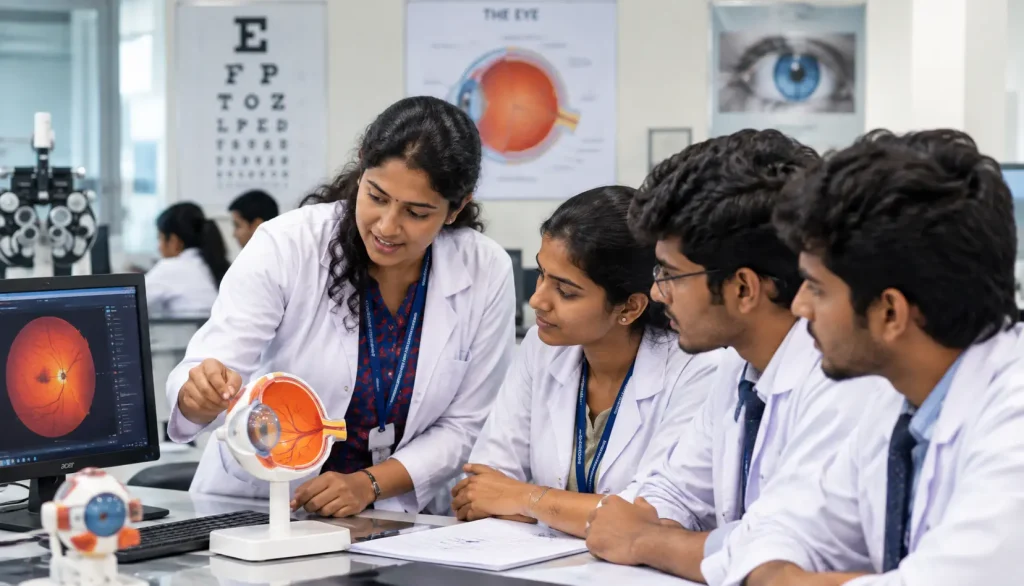
Choosing among optometry colleges in Kerala involves more than comparing course names. The university affiliation, clinical training environment, internship, curriculum, facilities and admission route can all affect the quality and relevance of your education.If you have completed Plus Two with a science background and are considering a career in eye care, this guide explains what to look for in an optometry college, how the course is structured, what admission requirements may apply and what career options are available after graduation.
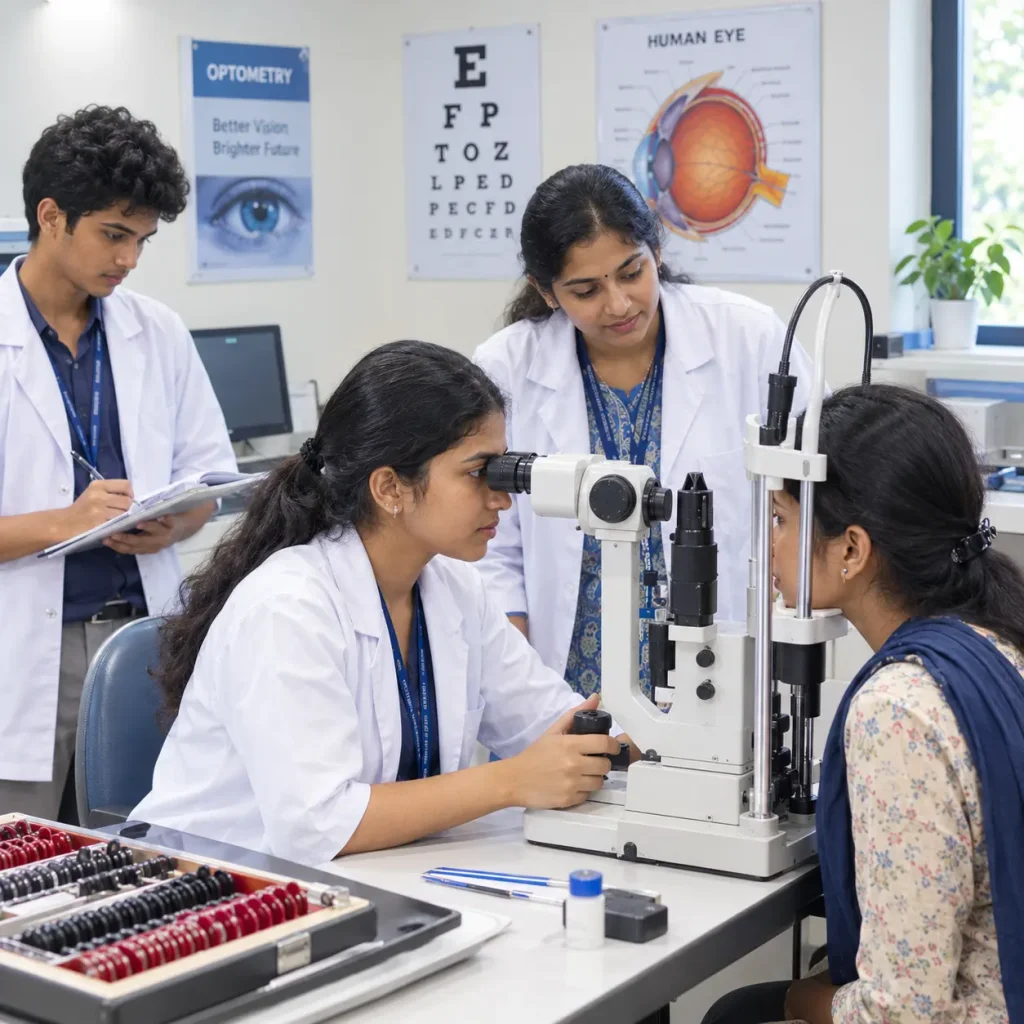
Optometry is a healthcare profession focused on vision and eye care. Depending on their professional scope and training, optometry graduates may work in areas such as vision assessment, refraction, contact lenses, low-vision care, community eye care and clinical support.
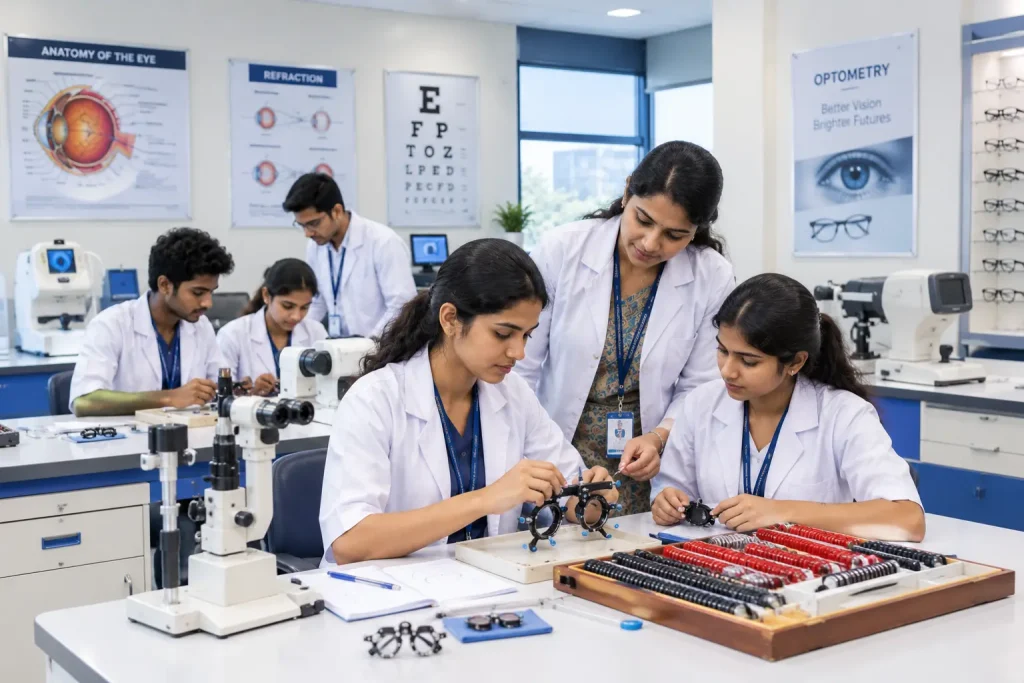
A Bachelor of Optometry or B.Sc Optometry programme generally combines classroom-based study with practical and clinical training. Subjects can include ocular anatomy and physiology, visual optics, optometric instruments, refraction, contact lenses, binocular vision, low vision and ocular diseases.
The exact course title and academic structure can vary between institutions, so students should check the current curriculum and university requirements before applying.
Kerala has several institutions offering undergraduate optometry programmes through different academic and admission structures.
Examples include government institutions, university-affiliated colleges and hospital-linked or self-financing institutions. Current institutional information shows optometry programmes at places such as the Regional Institute of Ophthalmology in Thiruvananthapuram, Government Medical College Kozhikode, Amrita's Kochi campus, KMCT College of Allied Health Sciences and Little Flower Institute of Medical Sciences and Research (LIMSAR), among others.
The Government of Kerala's Health Department also reports B.Sc Optometry intake at institutions including Ahalia School of Optometry & Research Centre, Al-Salama Eye Hospital and Al-Shifa College of Paramedical Science in its 2024–25 institutional data.
Because programmes, seats and admission procedures can change, use the college and official admission authority websites to verify the current status before submitting an application.
There is no single college that is automatically the right choice for every student. Your priorities may be different depending on location, budget, preferred learning environment and career plans.
Start with the academic status of the programme.Confirm which university the programme is affiliated with or awarded by and whether the specific course is currently approved or recognised under the applicable regulations.Do not rely solely on a college's general reputation. Verify the status of the specific optometry programme you intend to join.
Internship is an important part of undergraduate optometry education.
Instead of simply checking whether a college advertises an internship, look at what the internship actually involves. Find out whether students rotate through relevant clinical areas and whether the training provides meaningful supervised experience.
A strong clinical environment can help students connect subjects such as refraction, ocular disease, contact lenses and binocular vision with real patient care.
Ask the admissions team what support is available for internships, employment and higher studies.
Career pathways after optometry can include hospitals, ophthalmology clinics, optical establishments, vision-care centres, contact-lens practice, community eye-care programmes, research and the optical industry.
If you already have a particular career direction in mind, choose a programme that provides relevant clinical exposure and academic opportunities.
Students searching for "BSc Optometry colleges in Kerala" may encounter different terminology, including B.Sc Optometry and Bachelor of Optometry (B.Optom).
The name can vary between institutions and academic frameworks. Therefore, check the exact qualification awarded by the college and the university associated with the programme.
A typical undergraduate optometry programme involves academic study followed by clinical internship. For example, Amrita's Bachelor of Optometry programme is structured as four years plus one year of compulsory internship, while KMCT describes its B.Sc Optometry course as three years of coursework followed by one year of compulsory rotating internship.
The exact duration and curriculum should always be confirmed from the current prospectus of the institution you are considering.
Eligibility requirements can vary by institution and admission route.
For many undergraduate optometry programmes, students are expected to have completed Plus Two or an equivalent higher-secondary qualification with Physics, Chemistry and Biology.
For example, LIMSAR states that candidates need 50% marks in Physics, Chemistry and Biology together, with separate minimum pass marks in those subjects. KMCT similarly specifies Plus Two eligibility with requirements relating to Biology and the combined Physics, Chemistry and Biology marks.
Some institutions may have additional requirements relating to age, entrance examinations, documentation or selection procedures.
The admission process depends on the institution and programme.
Some institutions use merit-based selection or a centralised admission process, while others may have their own entrance examination or institutional selection procedure.
For example, Amrita's 2026 Bachelor of Optometry admission information states that selection is based on its entrance examination, while other Kerala institutions publish eligibility and merit-based admission requirements.
For government or centrally administered allied-health admissions, students should also check the current LBS Centre and Government of Kerala notifications.
Optometry students need to understand how theoretical knowledge translates into patient care.
A hospital-linked learning environment can expose students to real clinical workflows and patient presentations under appropriate supervision.
For example, Al Salama Education describes its B.Sc Optometry programme as combining classroom education with hospital-based clinical training and internship experience at its attached eye-care environment.
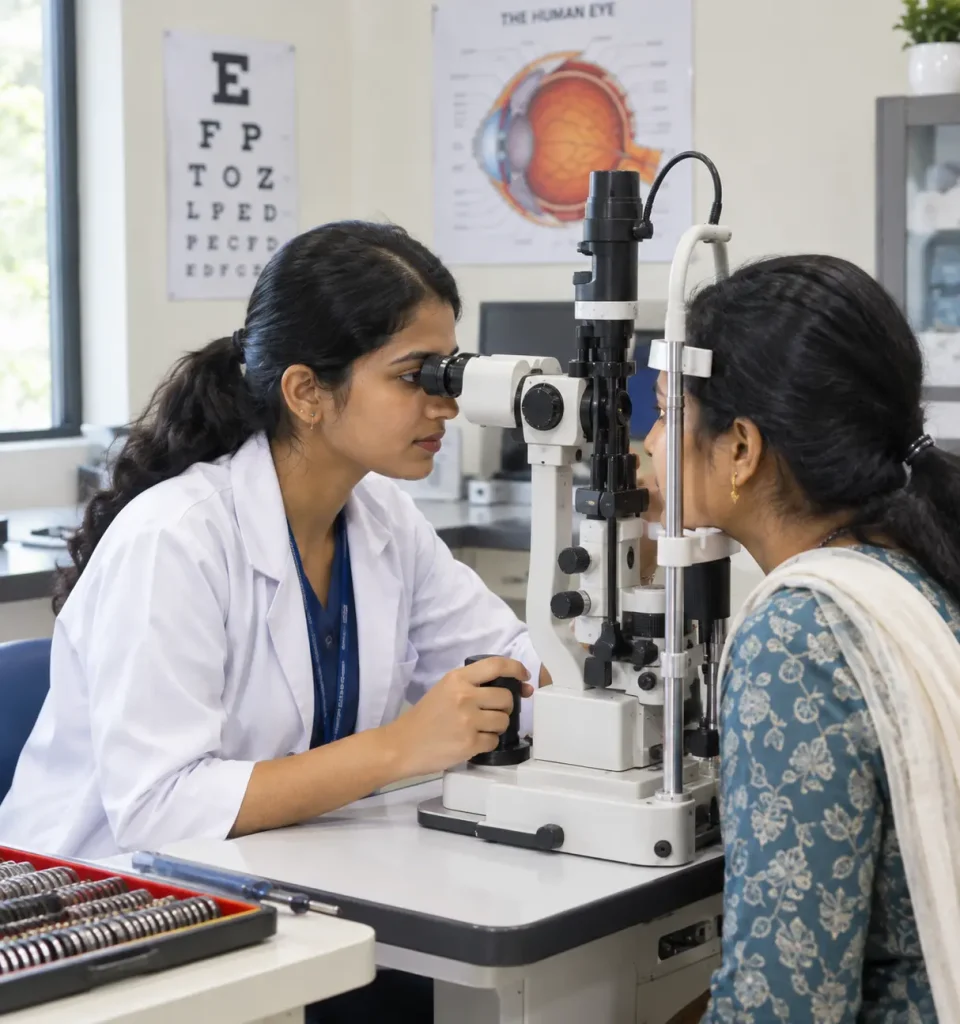
Al Salama Education, through the Al Salama Institute of Advanced Studies (ASIAS), offers optometry education in Perinthalmanna, Malappuram.Its B.Sc Optometry programme combines academic study with practical clinical exposure and hospital-based training. The institution currently describes the programme as a four-year course including internship and highlights areas such as ocular anatomy, visual optics, contact lenses, low vision, binocular vision and ocular disease.The institution also promotes an AI-integrated approach to optometry education, including the use of emerging healthcare technologies in the curriculum.
For students comparing optometry colleges in Kerala, Al Salama can therefore be evaluated using the same criteria outlined above
An optometry degree can lead to several career pathways within eye care and allied healthcare.
Graduates can work in clinical environments where optometry professionals support vision assessment, refraction, contact-lens services and other functions within their professional scope.
Optometrists can work in optical settings involving vision testing, spectacle dispensing, contact lenses and customer-facing eye-care services.
Students who develop specialist knowledge in contact lenses can pursue roles involving lens fitting, patient education and follow-up.
Community optometry programmes can provide opportunities to participate in screening, awareness and preventive eye-care activities.
Optometry graduates can also explore opportunities with organisations involved in ophthalmic equipment, lenses, contact lenses and related products.
Graduates may pursue postgraduate education such as a Master's degree in Optometry, depending on the eligibility requirements of the institution.Additional pathways may include research, teaching, public health and healthcare management.


