

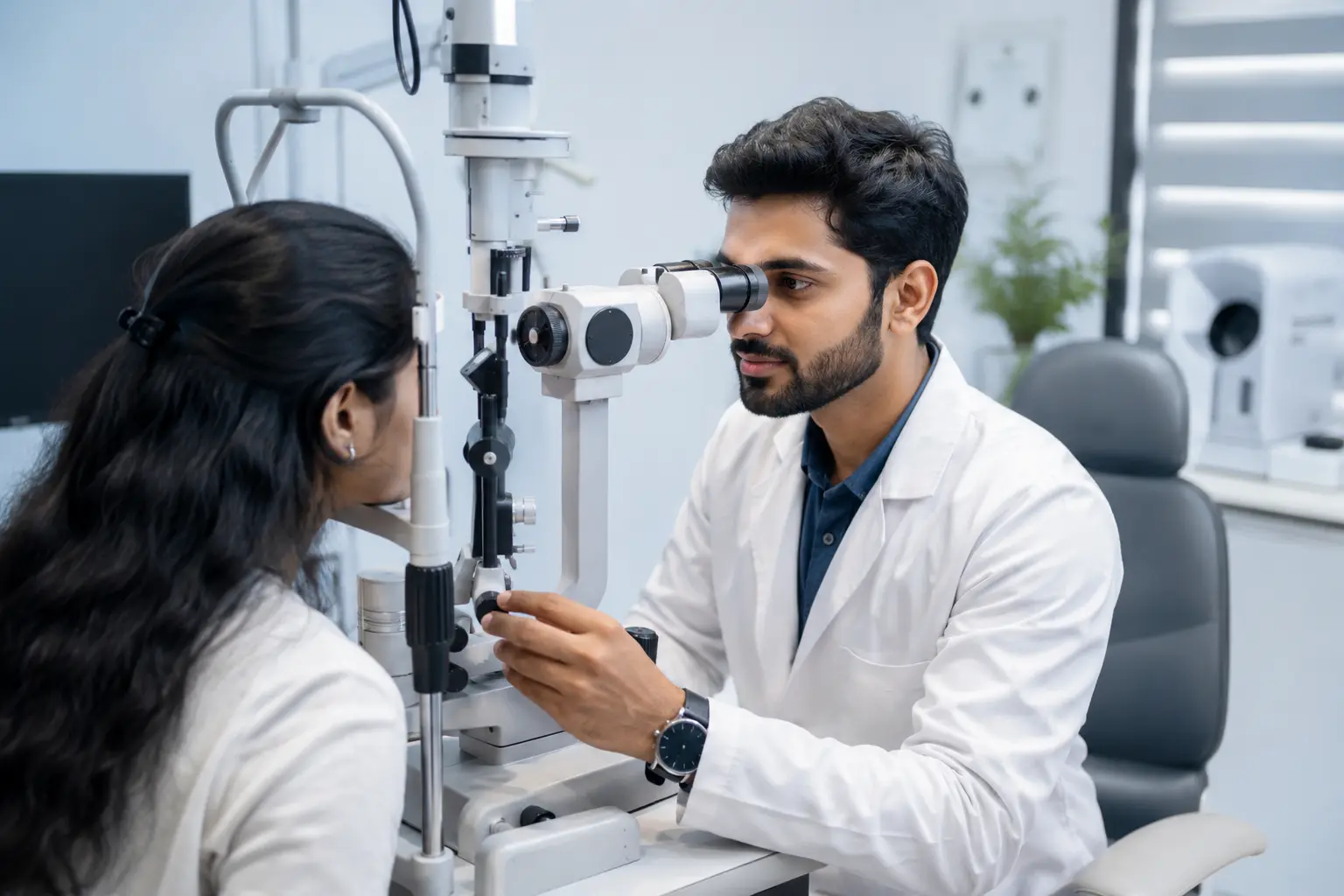
Is B.Sc Optometry a Doctor? The Complete Truth for 2026
What is BSc Optometry?
Is a B.Sc Optometry Graduate a Doctor?
| Dimension | Reality |
|---|---|
| Legal title “Doctor” | Not applicable to B.Sc Optometry in India |
| Can prefix “Dr.”? | Not permitted without a recognised doctoral qualification |
| Is optometry a healthcare profession? | Yes — officially recognised under AHPC Act 2021 |
| Can they examine eyes clinically? | Yes — fully trained and qualified |
| Can they prescribe medicines? | No — that requires an MBBS + specialisation |
| Can they perform eye surgery? | No — that is the domain of an Ophthalmologist |
| Scope in global context | In the USA, OD (Doctor of Optometry) degree holders use the title “Doctor” |
Why the Confusion Exists
Optometrist vs Ophthalmologist vs Optician
| Feature | Optometrist | Ophthalmologist | Optician |
|---|---|---|---|
| Qualification | B.Sc / M.Sc Optometry | MBBS + MS/DNB Ophthalmology | Diploma / ITI |
| Duration | 4 years | 10–12 years | 1–2 years |
| Title “Doctor” | No (India) / Yes (USA, OD) | Yes | No |
| Eye Examination | Yes | Yes | No |
| Prescribe Glasses | Yes | Yes | No |
| Prescribe Medicines | No | Yes | No |
| Perform Surgery | No | Yes | No |
| Fit Contact Lenses | Yes | Occasionally | Sometimes |
| Detect Eye Disease | Yes (detect & refer) | Yes (detect & treat) | No |
| Average India Salary | ₹3–8 LPA | ₹12–30 LPA | ₹1.8–3 LPA |
What Does an Optometrist Actually Do?
- Comprehensive eye examinations — visual acuity, refraction, binocular vision assessment
- Prescribing corrective lenses — spectacles and contact lenses
- Detecting ocular diseases — glaucoma screening, diabetic eye disease, retinal disorders
- Low vision rehabilitation — helping visually impaired patients maximise residual vision
- Pre- and post-operative care — managing patients before and after eye surgeries performed by ophthalmologists
- Paediatric vision screening — identifying amblyopia (lazy eye), squint, and refractive errors in children
- Occupational vision assessment — workplace eye health, visual ergonomics
- Vision therapy — treating convergence insufficiency and binocular vision disorders
According to the World Health Organization (WHO), approximately 2.2 billion people worldwide have a vision impairment, and at least 1 billion cases are preventable or yet to be addressed. Optometrists are central to closing this gap — especially in countries like India where ophthalmologist density remains low.
Eligibility & Admission
- 10+2 (Plus Two) with Physics, Chemistry, and Biology (PCB)
- Minimum aggregate: 50% marks (45% for reserved categories in some institutions)
- NEET is NOT mandatory for B.Sc Optometry in most institutions, though some states or colleges may use NEET scores for merit ranking
Admission Process
- Apply to colleges offering B.Sc Optometry (government or private)
- Qualify state-level or institution-level entrance tests (if applicable)
- Merit-based counselling and seat allotment
- Document verification and fee payment
Course Duration & Subjects
| Year | Key Subjects |
|---|---|
| Year 1 | Anatomy, Physiology, Biochemistry, Optics, Geometrical & Physical Optics |
| Year 2 | Ocular Anatomy, Ophthalmic Optics, Optometric Theory & Methods |
| Year 3 | Clinical Refraction, Contact Lenses, Binocular Vision, Ocular Diseases |
| Year 4 | Low Vision, Community Optometry, Paediatric Optometry, Internship |
Skills Required
- Attention to detail — minor errors in refraction affect patient quality of life
- Manual dexterity — handling ophthalmic instruments precisely
- Communication skills — explaining complex visual conditions in simple terms to patients
- Empathy — working with elderly patients, children, and those with low vision
- Analytical thinking — interpreting test results and making accurate clinical decisions
- Technological adaptability — proficiency with digital refractors, OCT machines, fundus cameras
- Patience — vision assessments require time and cooperation
Career Opportunities After B.Sc Optometry
Hospital & Clinical Settings
- Optometrist in eye hospitals (government and private)
- Consultant optometrist in multispeciality hospitals
- Pre- and post-operative refractionist in LASIK and cataract centres
Why study BSc Optometry at Alsalama Education?
Students who choose Alsalama can benefit from:
A healthcare-focused academic environment
Practical exposure and internship support
Career guidance for future opportunities
A Kerala-based location convenient for local students
A course structure designed for job readiness
Optical Retail Industry
- Optometrist in leading optical chains (Titan Eye+, Lawrence & Mayo, Lenskart, Vision Express)
- Branch manager / clinical head in optical chains
Corporate & Occupational Health
- Occupational vision consultant in IT companies and manufacturing units
- Vision screener in corporate wellness programmes
- Vision technician in NGO-led eye camps (OISCA, Sightsavers, Orbis)
- Community optometrist in government rural health programmes
Defence & Government Services
- Optometrist in Indian Army, Navy, Air Force medical corps
- State government health department postings
Salary
- Experience LevelSalary Range (India)Fresher (0–2 years)₹2.5 – ₹4 LPAMid-level (3–7 years)₹4 – ₹8 LPASenior / Specialist₹8 – ₹15 LPAAcademic / Research₹5 – ₹10 LPAAbroad (USA/UK/Canada)USD 60,000 – USD 120,000/year
Experience Level | Salary Range (India) |
Fresher (0–2 years) | ₹2.5 – ₹4 LPA |
Mid-level (3–7 years) | ₹4 – ₹8 LPA |
Senior / Specialist | ₹8 – ₹15 LPA |
Academic / Research | ₹5 – ₹10 LPA |
Abroad (USA/UK/Canada) | USD 60,000 – USD 120,000/year |
Government Jobs After B.Sc Optometry
- National Programme for Control of Blindness (NPCB/NPCBVI) — optometrists are recruited for district hospitals and vision centres
- ESIC (Employees’ State Insurance Corporation) hospitals — ophthalmic assistant / optometrist roles
- State Health Service Commissions — Kerala, Tamil Nadu, Karnataka, and UP regularly recruit optometrists
- Railways (RDSO) — vision testing roles
- Defence Medical Services — direct entry as Optometry Officer (after relevant qualification)
- AIIMS & Central Government Hospitals — optometrist posts under Group B staff
Abroad Opportunities for Optometrists
Indian optometry graduates have strong global mobility:
Country | Pathway | Requirement |
USA | OD (Doctor of Optometry) programme | 4-year OD after B.Sc Optometry |
UK | Pre-registration Optometrist programme | Pass College of Optometrists exams |
Canada | OD programmes or technician roles | State licensing exams |
Australia | Optometry registration via OCANZ | OCANZ assessment + AHPRA registration |
UAE / GCC | Hospital optometrist | MOH/DHA/HAAD licensing |
New Zealand | Optometrist registration | NZAO competency assessment |
The USA pathway is particularly popular: many Indian B.Sc Optometry graduates pursue OD (Doctor of Optometry) programmes at US universities, after which they hold a doctoral qualification and practice as "Dr." legally.
Higher Studies After B.Sc Optometry
Qualification | Duration | Career Advantage |
M.Sc Optometry | 2 years | Specialisation + academia |
M.Phil / Ph.D. in Vision Science | 2–5 years | Research & senior academia |
OD (USA) | 4 years post B.Sc | Doctoral title + expanded scope |
MBA in Hospital Administration | 2 years | Healthcare management roles |
PG Diploma — Contact Lens / Low Vision | 1 year | Clinical specialisation |
Specialisation areas in M.Sc Optometry include Contact Lens Practice, Paediatric Optometry, Low Vision & Rehabilitation, and Binocular Vision.
AI and Technology in Optometry
- AI-powered retinal screening: Tools like Google’s DeepMind AI and Remidio’s fundus cameras use machine learning to detect diabetic retinopathy with accuracy comparable to specialists. Optometrists operate and interpret these tools.
- Automated refraction: Digital autorefractors and AI-assisted refraction platforms (e.g., Smart Vision Labs) are reducing examination time and increasing accuracy.
- Tele-optometry: Remote eye examinations are expanding access in rural areas — a domain increasingly led by optometrists.
- OCT (Optical Coherence Tomography) with AI analysis: AI now assists in interpreting OCT scans for early glaucoma and macular degeneration detection.
- Wearable eye health devices: Smart glasses and continuous ocular monitoring devices are creating new roles for optometrists in preventive vision care.
Trend Alert: India's National Digital Health Mission (NDHM) is integrating tele-ophthalmology, and optometrists trained in AI-assisted tools are positioned as the primary workforce for this expansion.
Common Mistakes Students Make
- Confusing B.Sc Optometry with a medical degree — leads to mismatched expectations about scope of practice
- Choosing a college without NCAHP or state paramedical council recognition — renders the degree professionally invalid
- Neglecting clinical internship hours — internship quality determines job readiness
- Ignoring global qualification pathways — many students don’t know that a B.Sc Optometry can lead to an OD abroad
- Not pursuing specialisation after graduation — optometrists with M.Sc or post-graduate diplomas earn significantly more
- Overlooking AI and digital tool proficiency — technology fluency is now a baseline expectation in clinical hiring
- Expecting a doctor’s scope without a doctor’s qualifications — understanding the legal boundaries protects both the practitioner and patient
Expert Tips
For Students: Before selecting a college, verify its recognition under the NCAHP or the respective State Medical Faculty / Allied Health Professions Council. Unrecognised degrees create licensing issues.
For Career Counsellors: B.Sc Optometry is an excellent recommendation for PCB students who want a clinical healthcare career without a decade-long MBBS route. The course is 4 years, the career entry is early, and the global mobility is strong.
For Working Professionals: If you’re already a diploma-level optician or ophthalmic assistant, check bridge course eligibility to upgrade to a B.Sc Optometry — available in select institutions.
For Parents: Optometry is a regulated, government-recognised healthcare profession. The perceived status gap versus “doctor” courses is rapidly closing as optometrists become central to India’s vision care infrastructure.
Future Scope
India is grappling with a vision care crisis. According to the Indian Journal of Ophthalmology and data from the VISION 2020: The Right to Sight initiative:
- India has approximately 550 million people in need of refractive correction
- There are only ~18,000 practising ophthalmologists for a population of 1.4 billion
- The optometrist-to-population ratio remains critically low
This gap makes B.Sc Optometry one of the most future-proof allied health careers in India. Key growth drivers include:
- Increasing screen time and myopia epidemic among youth
- Ageing population driving demand for cataract, glaucoma, and presbyopia management
- Government expansion of eye care infrastructure under NHM
- AI and tele-optometry opening new service delivery models
- Growing optical retail market (projected to reach ₹15,000 crore by 2027)
Advantages & Disadvantages
Advantages
- Shorter route to a clinical healthcare career (4 years vs 10+ for MBBS)
- Internationally recognised profession with strong global mobility
- Growing demand due to India’s vision care gap
- Opportunity to pursue OD abroad and hold the “Doctor” title
- Diverse career paths — clinical, retail, research, academia, corporate, NGO
- AI and technology adoption creating new high-value roles
Disadvantages
- Cannot prescribe systemic or topical medications in India
- Cannot perform any surgical procedures
- Lower social recognition compared to MBBS doctors in India (changing gradually)
- Salary ceiling lower than Ophthalmologists
- Scope of practice legally restricted compared to international counterparts
- Quality of education varies significantly across institutions
Frequently asked questions
Is a B.Sc Optometry graduate called a doctor in India?
No. In India, B.Sc Optometry graduates are called Optometrists, not doctors. The prefix “Dr.” is not legally permitted for optometry graduates in India unless they hold a recognised doctoral degree. However, in the USA and several other countries, holders of a Doctor of Optometry (OD) degree are addressed as “Doctor” after a separate 4-year postgraduate programme.
Is NEET required for B.Sc Optometry?
Is there an entrance exam for BSc Optometry admission?
What is the difference between optometrist and ophthalmologist?
An optometrist holds a B.Sc or M.Sc in Optometry (4–6 years) and provides primary eye care, refraction, and disease detection. An ophthalmologist holds an MBBS plus a postgraduate degree (MS/DNB in Ophthalmology), which takes 10–12 years, and is qualified to prescribe medicines and perform eye surgeries. Both work together within the eye care team.
Can a B.Sc Optometry graduate work abroad?
Yes. Indian B.Sc Optometry graduates can work in Gulf countries (UAE, Kuwait, Saudi Arabia) with the appropriate Ministry of Health licence. For USA, Canada, UK, or Australia, additional qualifications or licensing examinations are required. The USA pathway — a 4-year OD programme — results in a doctoral qualification and broader scope of practice.
What is the salary of an optometrist in India?
Freshers typically earn ₹2.5–4 LPA. With 3–7 years of experience, earnings range from ₹4–8 LPA. Senior optometrists in hospitals or optical chains can earn ₹8–15 LPA. Those working abroad in GCC countries earn equivalent to ₹6–12 LPA (tax-free), and OD-qualified optometrists in the USA earn USD 60,000–120,000 per year.
Is B.Sc Optometry a good career choice for PCB students who don't want MBBS?
Absolutely. For students who want a clinical, patient-facing career in healthcare without the 10–12 year MBBS route, B.Sc Optometry is an excellent alternative. The course is four years, admission does not require NEET in most cases, employment is strong and growing, and the global pathway to a doctoral qualification (OD) exists for ambitious graduates.
What are the government job opportunities after B.Sc Optometry?
Government jobs include positions in state health services (through state public service commission recruitment), ESIC hospitals, AIIMS and central government hospitals, NPCBVI vision centres, defence medical services, and railway medical departments. The expansion of vision centres under the National Health Mission is creating new government vacancies specifically for optometrists.
Does AI threaten optometry as a career?
On the contrary — AI is expanding optometry’s role. AI-powered retinal screening, automated refraction, and tele-optometry require skilled optometrists to operate, supervise, and interpret results. The technology augments rather than replaces optometrists, and those fluent in AI-assisted tools are among the most sought-after professionals in modern eye care facilities.
What is the scope of optometry in Kerala?
Kerala has a strong eye care infrastructure with numerous private hospitals, government eye hospitals, and optical chains. Optometrists are in consistent demand in cities like Kochi, Thiruvananthapuram, Kozhikode, and Thrissur. Additionally, Kerala-based optometrists frequently pursue Gulf opportunities, where tax-free salaries and strong optometry demand make for excellent career outcomes.
Can I do M.Sc Optometry or PhD after B.Sc Optometry?
Yes. B.Sc Optometry graduates can pursue M.Sc Optometry (2 years) for clinical specialisation and better career prospects. After M.Sc, PhD or M.Phil in Vision Science is available for those interested in research or academic careers. Alternatively, graduates can pursue an OD programme abroad for a doctoral-level clinical qualification.
Conclusion
So, is a B.Sc Optometry graduate a doctor? In India — not by legal title. But they are far more than what that limitation suggests.
Optometrists are skilled, regulated, and essential healthcare professionals who form the backbone of primary eye care delivery. They detect diseases that threaten sight, restore vision through precise refraction, rehabilitate the visually impaired, and increasingly lead India's expanding tele-optometry and AI-assisted screening infrastructure.
For students after Plus Two who want a meaningful clinical career in healthcare, a shorter training path, and genuine global opportunities — B.Sc Optometry is a compelling and forward-looking choice. And for those who do want the "Doctor" title one day, the OD pathway in the USA is a clear, well-established route.
The question is not whether an optometrist is a doctor. The question is whether you are ready to become a professional who changes how millions of people see the world.

Post Info
Latest Posts

Why Optometry is One of the Most Promising Healthcare Careers in 2026
Professional consulting tailored to meet your unique

Top Paramedical Courses in Kerala for a Successful Healthcare Career
Reliable customer support designed to provide fast

How AI is Transforming Healthcare Education
Innovative design services that bring your creative

Hospital-Based Training: Why It Matters in Healthcare Education
Comprehensive marketing strategies focused on increasing brand


